


Solar panels — also known as photovoltaic (PV) panels — use solar energy to power your home. As a result, a residential solar panel system can help reduce your carbon footprint by relying less on the power grid. It can also lower your monthly electric bill. While that all sounds great, you still have a budget to consider and you’re likely wondering, “How much do solar panels cost?”
Well, the relatively high cost of solar panels can worry some prospective buyers.
Fortunately, you can offset some of these costs with federal and state incentives and rebates from utility providers. Join us as we delve into the average cost of solar panels, how long you can expect them to last, and whether they’re a cost-effective solution for your household.
How Much Do Solar Panels Cost?
The cost of a full solar panel system will vary greatly based on a number of variables, including the following factors:
- Home size: The larger the home, the more kilowatts you need to power it, and the larger system size you need. This all makes for a more expensive solar panel system.
- Sunlight exposure: The less direct sunlight exposure your rooftop has, the more panels you need to power your home and the higher the total cost of the solar panel system.
- Type of solar panel: Several types of panels exist — polycrystalline, monocrystalline, and thin-film — each with different benefits. The price will vary based on the type of panels you choose.
- On-grid or off-grid: Your price will also vary depending on whether you plan to tie the solar panel system into the local power grid or create a completely off-grid system.
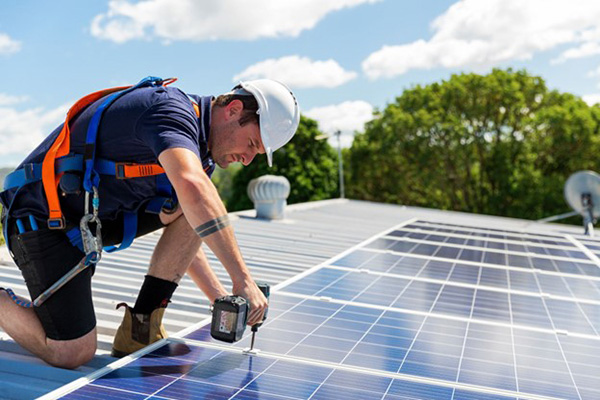
- Labor costs: You’ll likely need to hire a solar company to install the panels on your roof and an electrician to safely wire the inverter and other items. This cost will vary by geographical location and your chosen solar installation company.
In general, you can expect to pay about $2 per watt installed. As we mentioned above, though, the cost will vary by the type of solar panel you choose.
Monocrystalline panels are generally the most efficient at 15 to 22% efficiency, but they are a costlier option. Polycrystalline panels are a slightly lower cost, but they have only a 15 to 17% efficiency. Thin-film panels are flexible and portable, making them ideal for unorthodox roof designs, but they’re also lower efficiency than the two crystalline panels.
How Much Is a Solar System for a 2,000-Square-Foot House?
Keep in mind that the size of your home is only one factor in determining the size of your solar energy system. The best way to calculate the cost of your solar panel system is to first review your electric bills for the last 12 months. Identify the month when you used the highest amount of energy and use that as your baseline to calculate — after all, you’d rather have too much power than not enough.
According to the U.S. Energy Information Adminstration, the national average for energy usage is about 886 kilowatt-hours (kWh) per month. So, if you used 1,000 kilowatt-hours of electricity in the highest usage month, divide that by the number of days in the month to determine your daily usage. If that month had 30 days, your daily usage would be 33.33 kWh.
As such, you need a system that can create 33.33 kWh of electricity per day. Each 400-watt solar panel produces a median of 2 kWh per day, so you’d need 17 panels (33.33 / 2 = 16.665). This comes out to a 6,800-watt system (17 x 400 = 6,800 watts).
For an on-grid solar panel system, you can expect an average cost of $4.50 to $7 per watt installed, bringing the total cost to $30,600 to $47,600.
If you prefer an off-grid system at $5.50 to $8 per watt, including the solar panel installation costs, you’re looking at an overall cost of $37,400 to $54,400.
How Much Is a Solar System for a 2,500-Square-Foot House?

In general, the larger the house, the higher the energy needs, and the higher the solar system costs. Like the previous calculation, start by finding your highest energy bill over the past 12 months. The average 2,500-square-foot house uses 1,250 to 2,500 kWh of power monthly.
Averaging out the typical power-consumption range puts the average 2,500-square-foot house at 1,875 kWh of monthly electricity consumption. On a 30-day month, that’s 62.5 kWh per day, so you’d need 32 400-watt panels. This adds up to a 12,800-watt system.
A 12,800-watt on-grid system will cost $57,600 to $89,600 when factoring in the cost of installing the panels, while an equivalent off-grid system will run $70,400 to $102,400.
As with the previous calculation, this is only the average. Look at your highest utility bill to determine how much power you will need.
Your Satisfaction is Our Priority
We're confident you'll love your plan, but if not, call us, and we’ll help you find the perfect plan without any extra cost.*
Looking for energy plans for larger homes? Explore our Mega Saver Fixed-Rate Electricity Plan.
What About Tax Credits and Other Incentives?
The average prices listed above are before any federal, state, or local incentives and rebates. For example, solar power installed on homes between 2020 and 2021 were eligible for a 26% federal income tax credit. And all systems installed from 2022 through 2032 are eligible for a 30% tax credit. This credit falls to 26% in 2033 and 22% in 2034, then expires in 2035.
Given you met all the qualification requirements, you can claim this federal tax credit and get a dollar-for-dollar reduction in your owed taxes.
This tax credit doesn’t mean you’ll get a refund from the government if the credit exceeds your tax liabilities. However, you may get a refund if the credit results in overpaying income tax through your employer. If you don’t use your entire solar energy income tax credit in one year, you can use the remaining balance in the following years.
For example, if you receive a $25,000 tax credit for installing solar panels but only have a $10,000 tax liability that year, you can use $10,000 for the current year and roll the remaining $15,000 credit into the next year and beyond.
Non-government incentives, such as solar rebates from your electric provider, may also exist. Remember that these types of incentives are typically exempt from the federal tax incentive, so it’s deducted from the cost of the solar panels, which lowers the federal tax credit.
For example, if you receive a $1,000 rebate from your utility provider on a $50,000 solar panel system, the federal government will subtract that $1,000 from the $50,000 and base your 30% credit on $49,000.
How Long Do Solar Panels Last?
Solar panels aren’t cheap so it’s natural for many homeowners to consider longevity. Fortunately, solar panels have a long-projected lifespan of 25 to 30 years.
Also, this lifespan doesn’t mean you can expect the solar panels to stop working at the 25- to 30-year mark. Instead, this is when their efficiency reduces to a point where you may notice less power generation. However, they will continue generating some electricity.
For added insurance, many solar providers offer warranties to cover the panels’ efficiency. These warranties vary greatly and can range from five to 25 years. The best solar panels from top panel manufacturers tend to have the longest warranties.
Will Solar Panels Last 40 Years?
While not the norm, some well-made solar panels can far exceed the predicted lifespan. Some can even last as long as 40 years before you notice degradation.
Are Solar Panels Worth Your Money?
Whether or not solar panels are worth your money depends on your situation and a variety of factors, including the following:
- Local climate: Sunny climates like California, Florida and Arizona need smaller residential solar systems because they get more daily sunshine.
- Roof shape and steepness: An odd-shaped or steep roof pitch can make installation more difficult and increase the price.
- Amount of shade covering your roof: Mature trees surrounding your home can create large shade spots, meaning you’ll need more panels or a more complex installation to meet your power needs.
- Local and federal solar incentives: The federal incentive is great, but local incentives and utility rebates can make solar panels even more attractive.
- Household energy consumption: The more energy your household consumes, the larger system you’ll need, driving up the price.
Your safest bet is to contact local solar panel providers to schedule an in-home consultation. They will survey your space and give you an estimate on cost and potential energy savings.
When asking how much solar panels cost, review the proposed annual energy cost savings — this is generally about $1,346 per year — and multiply this by the typical solar panel lifespan of 25-30 years. If the savings are less than the net cost of the solar panels — i.e., solar panel costs minus the federal solar tax credit — then the panels are worth it.
Calculating the Cost of Your Solar Panels
When calculating the price of photovoltaic panels, don’t forget that they have a high upfront cost. As such, you may need a solar loan and make monthly payments. Review your financing options and the total cost of the loan you choose — total costs include all anticipated interest charges and other fees — and add this to the solar panel price.
For instance, let’s say you need a $35,000 solar panel system and qualify for a 12-year solar panel loan at 10% APR. That means you’d pay $25,231.94 in interest, bringing the total amount you pay to $60,231.94.
Now, let’s subtract the 30% federal tax incentive of $10,500 (assuming you qualify), giving us a total cost of $49,731. If you have the cash to pay for the panels in full, you can skip this step and use the net cost of $24,500 after the tax incentive.
Now that we have the total cost, let’s look at potential savings. Let’s say your system is set up to completely offset all your power usage even in the winter months, and your average monthly power bill is $200. So, that’s $2,400 in annual savings. In the summer months, you may produce more power than you use.
If your power company offers net billing, you can resell this excess power to the electric company — typically at the wholesale rate. Let’s say you resell $300 in power to the electric company during the summer months, bringing your total annual savings to $2,700.
You can get the same savings with net metering, but instead of reselling your excess electricity production to the power company, the power company gives you credits on a future bill.
Are these savings enough? That depends on your payback period, which we’ll cover next.
Find the perfect plan in 3 easy steps!
1 Enter your ZIP code
2 Choose your plan
3 Sign up in under 5 minutes
How Long Does It Take for Solar Panels to Pay for Themselves?
Your payback period determines if solar panels are worth your money or not. Once you reach this payback period, you’ve covered the cost of the panels and associated fees through savings and are getting free energy.
With all the costs and savings figured out above, let’s review the payback period — the amount of time it takes to break even on the net solar panel costs.
To do this, divide the net solar panel cost by the annual savings. So, with the loan we calculated earlier, we’d have an 18.4-year payback period ($49,731 / $2,700 = 18.419). Without the loan, the payback period is just 9.1 years ($24,500 / 2,700 = 9.07).
Typically, solar panels have a lifespan of 25 to 30 years, so they’re worth the investment in both cases — with or without the loan. Of course, without the added loan fees, you get many more years of use after the payback period.
Consider exploring our electricity bill calculator.
Contact Your Utility Company Before Deciding on Solar Panels
Before making any decisions, always contact your electric company and discuss their net-metering and power purchase agreement policies. Each company does it differently, and you don’t want to be surprised to learn your savings are much smaller than anticipated. One key variable to check is whether it offers credits for excess electricity based on net kilowatts used or net charges.
Billing by Net Kilowatts
Billing by net kilowatts is usually the most beneficial system for you. Let’s say you have 1,000 kWhs in energy usage, but your solar power system produces 1,500 kWh. In that case, the power company would subtract 1,500 kWh from your 1,000 kWh of usage and come up with a 500-kWh credit at the end of the billing period.
If the power company’s retail electricity rates are 20 cents per kWh and it purchases electricity at the wholesale rate of 10 cents per kWh, your credit is worth $50 that month (500 kWh x $0.10 = $50).
Depending on the power company’s policy, you can take this $50 as a payment or use it as a future credit on other bills.
Billing by Net Charges
Billing by net charges typically benefits the power company and can eat into your savings. Using the same numbers as above, the power company would bill you at the selling rate for 1,000 kWh of usage, which is $200. It will then calculate credit for your 1,500 kWh in energy production at the wholesale rate, amounting to $150 (1,500 kWh x $0.10 = $150). This leaves you with a net bill of $50.
A $50 credit versus a $50 net bill is a $100 monthly swing and can significantly impact your payback period.
Will Solar Panels Get Cheaper in 2023?
In 2022, the average price for a solar panel system increased 13% year over year (YoY), which makes prospective buyers wonder what 2023 has in store. However, thanks to more workers entering the solar installation field, government investments, supply-chain issue resolution, and the lift on certain solar panel import bans, experts believe solar prices will fall in 2023.
IHS Markit conservatively expects solar costs to fall 4 to 20% through 2028.
How Efficient Will Solar Panels Be in 20 Years?
Today, solar panels have an average efficiency rating of 20 to 23%. Some monocrystalline solar panels have tested as high as 42%, but those are lab tests and not valid in the wild. If you opt for thin-film solar panels, you can expect about a 5% efficiency reduction.
However, solar panel technology continues to evolve and improve, and this will continue over the next 20+ years. Over the next two decades, experts anticipate at least 46% efficiency. Experts also believe renewable energy technology will become more affordable over this time.
Solar Panels Can Pay for Themselves In Most Cases
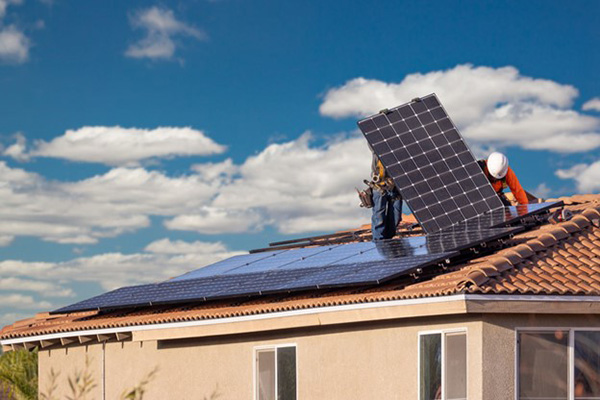
Solar panels aren’t the solution for everyone. For example, if you’re not a homeowner, have an incompatible roof, or have large, shade-creating trees surrounding your home, PV panels probably aren’t the best option for you.
In most cases, though, solar panels reach their payback period well before they begin degrading and losing efficiency, giving you plenty of time to enjoy the return on investment.
That said, you still want to get the answer to the question “how much do solar panels cost” for your area. Be sure to view all the other variables that go into calculating the potential savings they offer. If the savings exceed the total cost, you’re in good shape to save money by switching to solar.
You can start calculating the value of solar by first determining your energy consumption and cost of electricity. If solar panels don’t seem feasible, it might be time to consider switching suppliers. You could also opt for a green energy plan to offset your energy usage with clean energy and reduce your carbon footprint.
Brought to you by justenergy.com
All images licensed from Adobe Stock.
Featured image:

