

U.S. electricity customers went without power for an average of 11 hours in 2024, nearly twice the annual average of the decade before, and Hurricanes Beryl, Helene, and Milton accounted for 80% of those hours. Storms of that size turn a backup generator into the thing keeping the refrigerator cold and the sump pump running.
The first question most homeowners ask is what size generator they need. Square footage is the easiest place to start. However, appliance load and HVAC requirements matter just as much. Generac tells buyers to match a generator to peak electrical load rather than square footage, since two houses of the same size can need very different capacity.
Here’s a look at how to choose a backup generator by home size, what running and starting watts mean, what the equipment costs, and how to work out your own number.
Why Backup Generator Sizing Matters
A kilowatt is 1,000 watts. Kohler publishes a residential sizing chart that lists running and starting watts for household appliances. It puts one 4-ton air conditioner at 6,500 running watts. Sizing covers the hour when that compressor and everything else runs at once, not the average hour.
What Happens If a Generator Is Too Small?
An undersized generator overloads. On a standby unit, the breaker trips or the controller shuts the engine down to protect the alternator, leaving the house dark until someone resets it and removes loads. Undersized units also run near full output for hours, which is hard on this kind of engine. Generac’s air-cooled home standby generator manual describes them as an intermediate power supply for temporary outages rather than a prime power source.
Homeowners first notice the symptom with the air conditioner. It tries to start, the lights dim, and the compressor never reaches speed.
What Happens If a Generator Is Too Large?
Generac’s own guidance says bigger is not always better. Equipment price climbs steeply with capacity, from roughly $2,000 for a 7 kW unit to $16,000 in the 30 kW to 48 kW range. Installation costs climb with it, since a larger unit needs a bigger pad and heavier conductors.
Engines also run less efficiently under light load, so an oversized unit burns fuel at a poor rate covering a few hundred watts of refrigerator and lights.
Why Home Size Is Only Part of the Equation
Square footage tells you how much house there is to heat and cool, and not much else. HVAC is usually the largest single load in the panel. Kohler’s sizing chart puts a 4-ton central air conditioner at 6,500 running watts and 8,500 at startup, and a heat pump at 4,700 running and 10,000 starting. That is why generator size for a house depends on its equipment rather than its floor plan.
An electric water heater adds 4,000 watts, and a Level 2 EV charger at 30 amps delivers 7.2 kW on its own, more than a small standby generator produces. Electric dryers and pool equipment add even more.
For example, take two 2,200-square-foot houses. One runs on gas heat. The other has a heat pump, an electric water heater, and a charger in the garage. The latter lands in a different size class.
Backup Generator Sizing Chart by Home Size
The ranges below follow Generac and Kohler guidance and assume whole-home coverage with central cooling. Both publish these as starting points, and a dealer’s load calculation determines which band a house falls into.
Homes Under 1,500 Square Feet
Typical Generator Range: 10 kW to 14 kW
A unit this size generally covers:
- Refrigerator and freezer
- Lights and essential outlets
- Internet and networking equipment
- Small kitchen appliances
- A sump pump or well pump
Kohler assigns 10 kW to 14 kW to smaller homes and essential-circuit backup. Small houses, townhomes, and condos fit here, though attached-housing owners usually need association approval before siting a unit outdoors and tying it into the gas line.
Homes 1,501-2,500 Square Feet
Typical Generator Range: 14 kW to 20 kW
A unit this size generally covers:
- Central air conditioning
- Kitchen appliances
- Lighting throughout the house
- Home office equipment
Kohler describes this band as a fit for mid-sized homes that want most major systems covered, including central air conditioning. Generac calls 18 kW to 22 kW the sweet spot at 2,000 square feet, so an average family home with central air settles near the top of this range.
Homes 2,501-3,500 Square Feet
Typical Generator Range: 18 kW to 22 kW
A unit this size generally covers:
- Most household systems running at once
- Larger central HVAC units
- More than one refrigerator
- Washer and dryer
Generac calls this band whole-home protection for a mid-sized house, and arrives at it through load analysis rather than floor plan. Homes at the upper end often run a second HVAC zone, and that compressor pushes the number toward 22 kW.
Homes 3,501-5,000 Square Feet
Typical Generator Range: 22 kW to 30 kW
A unit this size generally covers:
- Two or more HVAC systems
- Whole-home backup
- Home theater equipment
- Pool equipment
- Large kitchens with multiple ovens
Kohler places 20 kW to 26 kW and above with larger homes running multiple HVAC systems. Pool equipment matters at this size, and Energy Star describes a pool pump as potentially a home’s second-largest energy user.
Homes Larger Than 5,000 Square Feet
Typical Generator Range: 30 kW and above
Sizing at this scale turns on:
- More than one electrical panel or subpanel
- Luxury appliances such as wine refrigeration and steam showers
- Well pumps, elevators, and shop equipment
- A professional load assessment rather than a chart
Kohler says plainly that a professional load assessment, with a dealer evaluating the panel and calculating both starting and running wattage, is the most accurate way to size a generator. Above 5,000 square feet, it is the only reliable method.
Generator Size by What You Want to Power
Two houses of identical size can need generators 15 kW apart on this decision alone. Here’s a closer look.
Essential Circuits Only
Essential-circuit backup covers a short list through a small transfer switch:
- Refrigerator
- Lights in main living areas
- Internet and device charging
- Medical equipment such as an oxygen concentrator
- Sump pump
Add the Kohler figures for that list and the running total sits near 2,500 watts, with the sump pump asking 1,000 watts at startup. That fits inside the smallest standby units and many portables.
Partial Home Backup
Partial-home backup adds the systems that make a house livable for several days:
- Kitchen appliances
- One HVAC zone
- Bedroom outlets and lighting
- Garage door opener and garage circuits
Adding one HVAC zone is what separates partial-home backup from essential circuits. Adding a 4-ton air conditioner at 6,500 running watts and 8,500 starting watts to a 2,500-watt essential list roughly quadruples the requirement.
Whole-House Backup
Whole-house backup covers every circuit in the panel, so the figure you work from in whole-house generator sizing is the total load, roughly 11,200 watts for the house in the example above.
An automatic transfer switch watches the utility, and when the power drops, it disconnects your house from the grid, starts the generator, and moves the load over without anyone going outside. Installed, that switch costs $600 to $2,500.
When utility power returns, the switch transfers back and the generator shuts down after a cooldown. It also keeps generator output off the utility lines, which is what makes the installation safe for the crews working on them.

Understanding Running Watts vs. Starting Watts
Appliance nameplates carry running watts. Starting watts appear only in manufacturer sizing charts, which is why Kohler’s residential sizing chart shows every appliance’s running and starting watts side by side.
What Are Running Watts?
Running watts are the continuous draw an appliance needs while operating. Kohler’s chart lists a refrigerator at 700 watts, a microwave at 900, a coffee maker at 1,500, a toaster at 1,650, and a desktop setup at 800.
An electric water heater pulls a steady 4,000 watts while it’s on. Add up running watts first, since a generator’s total wattage starts with that amount.
What Are Starting Watts?
Starting watts are the extra power an appliance needs when it switches on. A motor or compressor draws it because the parts have to start turning from a standstill. Once the appliance reaches its running speed, the draw drops back to its running watts.
Generac describes starting wattage as often two to three times the running figure. For example, a washing machine runs at 1,200 watts and starts at 2,300, and a 1/3 HP garage door opener runs at 600 and starts at 1,600.
Why Air Conditioners Affect Generator Size
Central air conditioning combines the largest running load in most homes with one of the largest surges. Kohler’s chart puts a 32,000 BTU unit at 5,000 running watts and 6,100 starting, a 48,000 BTU unit at 6,500 and 8,500, and a 60,000 BTU unit at 9,200 and 11,900.
A heat pump is steeper still, at 4,700 running watts against 10,000 at startup. Generac’s formula adds all running wattages to the single highest starting surge, and in nearly every house that surge belongs to the air conditioner.
Common Appliances and Their Power Requirements
The figures below come from Kohler’s residential sizing chart. Here’s a closer look at the four groups that move the calculation most.
Kitchen Appliances
Kohler’s chart lists these kitchen loads:
Refrigerator and freezer combination: 700 running watts, 1,800 starting watts
Standalone freezer: 500 running watts, 1,000 starting watts
Microwave oven: 900 running watts
Electric range, 8-inch element: 2,100 running watts
For instance, a refrigerator and a chest freezer running together sit at 1,200 watts, but if both compressors kick on in the same second, the draw briefly reaches 2,800 watts. A dishwasher adds to the total whenever its heating element runs.
Comfort Systems
Heating and cooling is where most of the capacity goes:
Central air conditioner, 32,000 BTU: 5,000 running watts, 6,100 starting watts
Central air conditioner, 48,000 BTU: 6,500 running watts, 8,500 starting watts
Heat pump: 4,700 running watts, 10,000 starting watts
Furnace fan, 3/4 HP: 800 running watts, 2,000 starting watts
A gas furnace needs only its blower and controls, which is why homes on gas heat need a smaller generator than their square footage suggests. Electric resistance heating is the opposite case, drawing its full rating the entire time it runs.
Household Equipment
Laundry, water heating, and pumps make up most of the remaining fixed load:
Washing machine: 1,200 running watts, 2,300 starting watts
Electric water heater: 4,000 running watts
Well pump, 1/3 HP: 1,000 running watts, 2,000 starting watts
Sump pump, 1/3 HP: 400 running watts, 1,000 starting watts
A well pump matters more than its running figure suggests, since it doubles to 2,000 watts at startup and runs on demand. An electric dryer sits on a 240-volt circuit like the water heater, and most homeowners leave it off the generator.
Modern High-Demand Loads
Newer equipment changes sizing more than anything above:
Level 2 EV charger: up to 7.2 kW at 30 amps
Pool pump: potentially a home’s second largest energy user
Home office workstation: about 800 watts
Smart home hubs, cameras, and networking: small but continuous
The Alternative Fuels Data Center puts most residential Level 2 chargers at up to 30 amps, delivering 7.2 kW. One left connected during an outage takes half of a 14 kW generator’s output by itself.
Standby Generators vs. Portable Generators
Your choice between standby and portable generators affects installation, operation, and safety. Portable generators run on fuel you bring to them, while standby units connect to a gas line and sit on a concrete pad installed by a professional.
Portable Generators
Portable units cost $500 to $2,500. Transfer switches cost another $400 to $1,300 for a transfer switch. You can move them, store them between storms, and use them away from the house; they connect through that switch or through cords run to individual appliances. Portables run from about 1,000 watts up past 20,000, so the larger ones overlap the standby range. The difference is that someone has to be there to run them.
The trade-offs are operational and serious. Someone has to go outside during the storm to start the unit, refuel it every few hours, and shut it down. The Consumer Product Safety Commission recommends running portable generators outdoors only, at least 20 feet from the house, with exhaust directed away from windows, doors, and vents. An average of nearly 100 people a year die of carbon monoxide poisoning caused by portable generators.
Whole-House Standby Generators
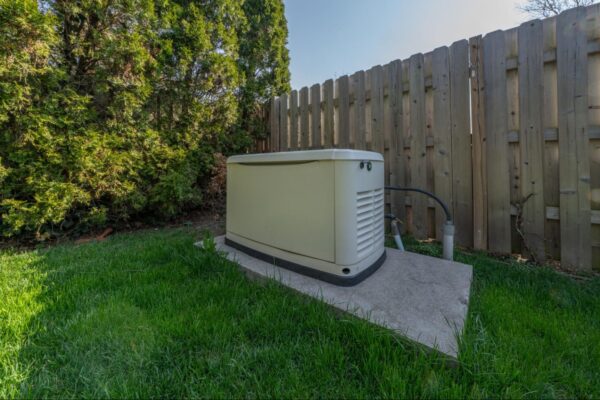
A whole-home generator is installed on a permanent pad and connects to natural gas or propane. It is wired into an automatic transfer switch and starts up without user intervention when the main power supply goes out. The generator runs self-tests at regular intervals, which helps detect issues before they become problems during a power outage. Generac air-cooled units can be set for weekly, biweekly, or monthly self-tests that last about 5 to 12 minutes.
The cost to install a whole-house generator usually ranges from $6,000 to $11,000. The equipment itself for a typical 17 kW to 20 kW unit is priced between $4,000 and $6,000.

Plans With Perks
Enjoy free nights or weekends and earn bill credits, making your electricity plan work for you.
Fuel Options for Backup Generators
The type of fuel used will affect how long the generator can run and how often it needs refueling. Most residential standby systems use natural gas or propane. Larger systems may use diesel. Some modern options use batteries to avoid combustion altogether.
Natural Gas
Natural gas arrives by pipeline, so a standby unit connected to it has no tank to fill and no runtime limit from fuel supply. The line has to carry the generator’s demand in cubic feet per hour alongside the furnace, water heater, and range, a calculation the installer performs before the unit is ordered.
Propane
Propane is stored under pressure in a tank as a colorless, odorless liquid and vaporizes back into gas as that pressure is released. In liquid form, it has an energy density 270 times greater than as a gas, which lets a yard tank hold enough to matter.
Diesel
Diesel generators are common for bigger jobs, like commercial buildings, farms, or homes needing more than 30 kW. These engines can handle long, high-load runs. But if your house already has utility gas, the extra storage and handling needed for diesel usually aren’t worth it.
Solar Generators
Solar backup pairs rooftop panels with a battery and an inverter rather than an engine. A Tesla Powerwall 3 holds 13.5 kWh of nominal battery energy and delivers up to 11.5 kW, with a load start capability of 185 LRA for motor startup. That output matches a mid-size standby unit until the 13.5 kWh is spent. A house drawing 2,500 watts empties the pack in about five hours, after which recharging depends on the sun rather than a fuel line.
How Much Does a Backup Generator Cost?
The figures below are national averages compiled in December 2025, with equipment, labor, and the transfer switch priced separately.
Portable Generator Costs
Entry-level portables start around $500 and cover a refrigerator, some lights, and charge devices. Mid-range models run to $2,500 and can carry a window air conditioner or a well pump alongside the essentials.
A transfer switch adds $400 to $1,300 and lets the unit feed household circuits instead of extension cords.
Standby Generator Costs
Standby generator size is the main factor in equipment price, shown here before labor is added:
- 7 kW to 10 kW: $2,000 to $3,000
- 13 kW to 16 kW: $3,000 to $4,500
- 17 kW to 20 kW: $4,000 to $6,000
- 22 kW to 25 kW: $4,500 to $12,000
- 30 kW to 48 kW: $10,000 to $16,000
Installation labor averages $3,000 to $5,000 on top of the equipment, and $5,000 to $12,000 or more for units above 20 kW or long conduit runs. An automatic transfer switch runs $600 to $2,500 installed.
Long-Term Value Considerations
Five costs land on a household during a long outage:
- A full refrigerator and freezer replaced after a multi-day outage
- Heating or cooling through a storm that outlasts the forecast
- Remote work and home-business income during a weekday outage
- Running water in homes on a well, where no power means no pump
- A hotel bill for however long the house stays cold or dark
Interruptions attributed to major events averaged nearly nine hours in 2024, against nearly four hours a year from 2014 through 2023. With major events set aside, the annual average is about two hours per year, which is the baseline a generator faces the rest of the time.
How to Calculate the Right Generator Size for Your Home
Generac states the formula as the sum of all running wattages plus the single highest starting wattage burst. That formula is what any backup generator calculator applies, and here’s how to work through it by hand.
Step 1: List Essential Appliances
Look at your home’s electrical panel for the directory inside. It lists each circuit, helping you decide which items are top priority to keep on during a power outage, such as the refrigerator, sump pump, or medical equipment. Devices like the dryer or a second oven can stay off until regular power returns.
Step 2: Calculate Running Wattage
Find the nameplate on each appliance (usually inside the door or on the back). This label shows the running wattage or amps used. If it lists amps, multiply that number by your home’s voltage to get the wattage.
If you can’t find the label, use an appliance wattage chart for estimates, such as the one Kohler provides. For example, a typical refrigerator may need 700 watts, a freezer 500, a furnace fan 800, a sump pump 400, and lighting about 300 watts. Together, the total running wattage is 2,700 watts.
Step 3: Account for Startup Loads
When choosing a generator, remember that appliances with motors don’t all start at the same time. You only need to factor in the highest starting wattage for any one device on your list.
For example, if you add a 4-ton air conditioner to your setup, its 6,500 running watts bring your total to 9,200 watts. Since the air conditioner has a starting surge of 8,500 watts, you add only the difference, 2,000 extra watts, to your running total. In this case, your generator should supply about 11,200 watts.
Generac writes the formula as running watts plus the highest starting burst. In practice, you only add the extra watts that burst needs beyond what the appliance already draws while running, since the compressor’s running load is already in your total.
Step 4: Build in Safety Margin
Pick a generator that provides more power than your calculations suggest. This extra wattage gives you a safety margin if you want to run more appliances later on. For instance, if your total load is 11,200 watts, choose a 14 kW generator rather than a 12 kW one. Having extra capacity can also help if you add something like a Level 2 electric vehicle charger, which can use 7.2 kW and take up a large portion of your generator’s output.
Step 5: Consult a Professional Installer
It’s a good idea to ask a professional installer for help when choosing a generator. Kohler says plainly that a full load assessment is the best way to find the right size for your needs.
Installers also handle other important details, such as checking the gas line, ensuring the generator is far enough from buildings, handling permits, and installing the transfer switch. These steps go beyond simply adding up wattages.
Frequently Asked Questions
Yes. Backup power for home use at that scale needs a permanently installed standby unit and an automatic transfer switch sized to the whole panel. Kohler recommends 20 kW to 26 kW and above for homes running more than one HVAC system.
It depends on how long your outages last and whether someone will be home to run the equipment. A portable unit costs $500 to $2,500 and requires manual starting, refueling, and placement at least 20 feet from the house. A standby costs $6,000 to $11,000 installed and starts on its own.
Yes, as long as the generator covers the compressor’s starting surge. Kohler lists a 48,000 BTU central air conditioner at 6,500 running watts and 8,500 at startup, and a 60,000 BTU unit at 9,200 and 11,900. A 5-ton system alone takes most of a 14 kW generator’s output.
Most residential Level 2 chargers operate at up to 30 amps and deliver 7.2 kW, which a mid-size generator can supply. The charger competes with the rest of the house for that capacity, so many owners fall back to a Level 1 cordset at 1.9 kW during an outage.
A standby generator on a natural gas line has no fuel limit, but the engine has service intervals. Generac’s manual for its 9 kW to 22 kW air-cooled units calls for an oil and filter change every two years or 200 hours (whichever comes first), and states the units are an intermediate power supply for temporary outages rather than a prime power source.
They are, within their stored capacity. A Tesla Powerwall 3 holds 13.5 kWh and delivers up to 11.5 kW, with a 185 LRA load start rating that covers a compressor. Overnight, it runs on whatever the panels made that day, which cloud cover and short winter days limit.
Your Power, Your Terms
Pick from short-term or long-term plans to enjoy maximum flexibility. You call the shots!
Prepare Your Home for the Next Power Outage
Choosing a backup generator by home size puts a house in a 10 kW to 30 kW band to start. The air conditioner sets the ceiling, at 8,500 starting watts for a 4-ton unit. The choice between six circuits and the whole panel moves it further than either.
The list of circuits that stay live is the whole calculation. Once you have it, a portable unit, a standby system, and a battery are three home backup power options that cover the same wattage at three different prices.
Just Energy can help you understand your household energy usage and explore ways to improve your home’s energy resilience. Learn more about home energy solutions.
Brought to you by justenergy.com
All images licensed from Adobe Stock.