

Texas registered 456,667 electric vehicles and plug-in hybrids by the end of 2025, more than triple the July 2022 count. EV charging stations in Texas are also easier to find than in most states. Here’s a closer look at how many chargers Texas has and where they sit, what today’s EVs cover on a charge, the tools that find a plug near you, and what home charging does to your electric bill.
How Many EV Charging Stations Are in Texas?
The number of EV charging stations in Texas shifts month to month as new sites come online. The federal database most charging apps use is the best place to check current numbers.
Texas Has Thousands of Public Charging Stations
As of September 8, 2026, Texas has 3,746 public EV charging station locations and 12,534 public charging ports, according to the U.S. Department of Energy’s Alternative Fuels Data Center. A station location is one site, and each site usually has several ports, which is why the second number runs so much higher.
That ranks Texas among the leading states for public charging, and the count keeps growing as vehicle numbers rise.
Growth of EV Charging Across Texas
A growing share of Texas EV charging stations is funded by federal money, though private networks built most of what’s on the map today. Texas was allocated $323 million through the National Electric Vehicle Infrastructure program for fiscal years 2022 through 2026.
The first round allocated $53 million to 65 sites, 15 of which are open and accepting vehicles. Later rounds are reaching beyond the metro areas where private operators built first.


Where Are EV Charging Stations Located in Texas?
The electric vehicle charging stations Texas drivers use are concentrated in a few parts of the state, so a statewide count says little about what any one driver can reach.
Major Texas Cities Have the Most Chargers
Dallas-Fort Worth and Houston have the heaviest concentrations, followed by Austin and San Antonio. Most of them are at shopping centers, office parks, and hotels, where cars are already parked for an hour or more.
El Paso is its own case, with chargers in town and then several hundred miles of I-10 before the next metro area of any size.
Charging Along Major Highway Corridors
I-35, I-10, I-45, and I-20 are designated alternative fuel corridors, which is where the federal program built first. The Federal Highway Administration certified in January 2026 that the Texas corridors are fully built out.
The federal money came with specifications. Stations sit no more than 50 miles apart, no more than one travel mile off the highway, each with at least four 150-kilowatt DC fast ports. Fifty miles matters, since a driver who passes one station can still reach the next on a low battery, which is what closes the gaps between cities.
Rural Charging Access Is Expanding
Phase II money is aimed past the corridors, at the county seats and metro areas the first round didn’t reach. Filling those gaps is what makes long-distance travel across the state practical.
Local planners are also working to improve access. The North Central Texas Council of Governments keeps a list for the Dallas-Fort Worth area. Their updated plan highlights the main town in each rural county, as well as US 287 and US 380, as possible sites for new stations.
What Is the Average Range of an Electric Vehicle?
How far apart chargers can sit depends on how far the cars go between them. That said, the electric vehicle range has improved a lot in just a few model years.
Most New EVs Can Travel 250–350 Miles on a Full Charge
Range can vary more within a single model than between different brands. For example, the 2026 Hyundai Ioniq 5 is EPA-rated at 318 miles with rear-wheel drive and 245 miles for the standard-range SE, a difference of 73 miles.
The Chevrolet Equinox EV loses 12 miles of range when switching from front-wheel to all-wheel drive, dropping from 319 to 307 miles. The Ford Mustang Mach-E can go 320 miles with the extended-range battery and rear-wheel drive, or 260 miles with the standard battery.
Even the base models can go over 200 miles on a charge. The battery and drivetrain you choose have a bigger impact on range than the brand itself.
Factors That Affect EV Range
The number on the window sticker is not the lab result. The EPA multiplies its dynamometer figure by roughly 0.7 before printing it, which is how a car that ran 200 miles on the highway test ends up labeled at 140.
What moves it on any given day:
- Speed, which costs more range than anything else on this list above, at about 70 mph
- Air conditioning or heating use
- Elevation changes, like the Hill Country climbs west of Austin
- Weight, from passengers to a bike rack on the back
- Battery age, which trims capacity a little each year
Why EV Range Matters in Texas
Because Texas is the second-largest state, having stations every 50 miles is more important here than in smaller states like Connecticut. Long drives are common, so drivers often plan their charging stops and use the same ones on each trip.
Why Knowing Where Charging Stations Are Located Matters
The map decides whether an EV is the commuting car or the one the household takes to Big Bend.
Avoiding Range Anxiety
EV range anxiety is the worry that the battery will run out before you reach the next charger. More charging stations within reach can help ease those worries, as can planning stops ahead of time.
Road Trip Planning
You can drive from Austin to San Antonio and back on a single charge in almost any current EV. Dallas to Houston usually requires a full battery and careful driving in a standard-range car. Every EV will need multiple stops to get from Houston to El Paso.
Emergency Charging Situations
Plans change on the road. A wreck that closes I-45 sends traffic onto the frontage roads, and a car crawling in stop-and-go traffic still runs its air conditioning while covering very few miles. Winter storms have the same effect.
A 30-mile detour can cost more than 30 miles of range. For that reason, many drivers plan two or three chargers along a route instead of one.
Apartment and Condo Residents
Home charging assumes there’s an outlet within a cord’s reach of the car, and assigned surface parking at a leased apartment rarely has one. Those drivers run on public charging, mostly Level 2 units at work and the grocery store.
Types of EV Charging Stations
Charging speed is the difference between an overnight fill and a coffee-break top-off. Three categories cover almost everything on the map.
Level 1 Charging
Level 1 uses a standard 120-volt household outlet and adds roughly five miles of range per hour. That covers a short commute if the car stays plugged in overnight, and it costs nothing when an outlet is already there.
Level 2 Charging
Level 2 runs on 240 volts, the same service a clothes dryer uses, and adds about 25 miles of range per hour. It’s the most common type in driveways and public lots alike, and an overnight charge covers nearly any daily driving.
Texas has 7,249 Level 2 ports, well over half the state’s public total.
DC Fast Charging
DC fast charging is the highway option, adding roughly 100 to 200+ miles of range in 30 minutes. Texas has 5,285 DC fast ports, and federal corridor funding supports them.
Best Resources for Finding EV Charging Stations in Texas
Several tools map EV charging stations in Texas, each with different strengths. Most EV drivers keep two resources they can count on on their phones.
U.S. Department of Energy Alternative Fuels Data Center
The Station Locator is the federal database sitting underneath much of what the other apps show. Search by location or map a route. The default view shows stations open to the public.
TxDOT EV Charging Resources
TxDOT keeps a Texas electric vehicle charging map and guide, plus a statewide dashboard of station locations, including sites planned or under construction rather than open. Check it to see whether there’s a new charging station coming to your route.
Tesla Charging Network
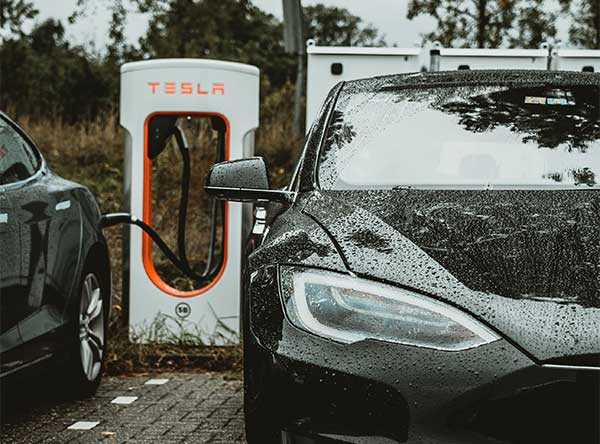
Tesla’s Superchargers add up to 200 miles in 15 minutes. Destination Charging is the slower half, with Wall Connectors at hotels and restaurants delivering up to 44 miles of range per hour.
PlugShare
PlugShare maps stations across networks and layers the EV community’s own reviews, photos, and charging tips on top of them.
ChargePoint
ChargePoint hardware turns up in Texas office garages and grocery lots, usually the Level 2 units a landlord installed. Its app finds them, shows which stalls are open, and handles payment.
Manufacturer Apps
Automaker apps have one thing the others don’t: your actual battery level. FordPass, the Rivian app, Hyundai’s Bluelink, and GM Energy each plan a route around the charge your car has left.
Public Charging vs. Home Charging
Which one a driver leans on depends on whether there’s an outlet where the car sleeps.
Benefits of Public Charging
Public charging is what makes long trips possible. A stop at a DC fast charger, long enough for a restroom and a coffee, puts most of a battery back, and Level 2 units in downtown garages add range while the car sits through a workday.
Benefits of Home Charging
Most EV drivers charge overnight at home on Level 1 or Level 2 equipment. The car fills while everyone sleeps and starts each morning full, which removes the fuel stop from the week.
It’s usually the cheaper electricity too, since you pay your residential rate instead of a station operator’s price.
Why Electricity Plans Matter for EV Owners
Home EV charging in Texas households moves fuel spending off the gas station receipt and onto your electric bill, making the rate you signed more impactful than before.
Every Texas plan publishes an Electricity Facts Label with average prices at 500, 1,000, and 2,000 kWh. An EV pushes a household up that scale, so the row describing your usage may not be the row it used to be.

Serving Texas for Over 20 Years
Trust the legacy – we've proudly served the Lone Star State for over 20 years, delivering first-class energy solutions that stand the test of time.
How EV Ownership Can Affect Your Electric Bill
EV charging costs in Texas come down to arithmetic you can run from your own numbers.
Additional Monthly Energy Usage
Your EV’s window sticker lists kilowatt-hours per 100 miles. Multiply that by the miles you drive in a month, divide by 100, and you have the kWh the car adds to the house.
Efficiency is the variable. A small hatchback and a full-size electric truck driven the same 1,000 miles land in different places on the bill, and the sticker shows what you can expect before you buy.
Managing EV Charging Costs
- Set your car to start charging after your household’s evening peak hours.
- Keep your daily charge around 80%, and only charge to full before a long trip.
- Look at your Electricity Facts Label to see if your plan offers lower rates during off-peak hours.
- After your first full month with the car, check your usage history in your provider’s account.
Compare Electricity Plans Before Installing a Home Charger
Installing a Level 2 charger is planned work rather than an emergency, so it’s a good time to compare Texas electricity plans for EVs. Pull your last 12 months of usage, add the car’s estimated kWh, and shop against that total.
Choosing the right electricity plan can help Texas EV owners better manage charging costs and overall household energy expenses.
The Future of EV Charging in Texas
Texas EV infrastructure is still expanding, so the map a driver uses today will look different in a few years.
More Chargers Are Being Added Every Year: The Texas Transportation Commission approved roughly $250 million in grants for 147 new charging stations in April 2026, more than double the number of sites in the first round.
Faster Charging Technology: Federal rules set a 150-kilowatt floor for corridor stations. In practice, a faster charger means a shorter stop rather than a different route.
Growing EV Adoption Across Texas: Registrations keep pace with the hardware. Texas adds about 1,500 electric vehicles a week, according to Texas Department of Motor Vehicles data. Infrastructure plans are sized against that curve rather than today’s count.
Frequently Asked Questions
Texas has thousands of station locations holding tens of thousands of individual ports. The Alternative Fuels Data Center publishes a running count that updates monthly.
Typing EV chargers near me Texas into a phone will usually surface the Station Locator, PlugShare, or your automaker’s app. Set the connector filter before you search. Without it, the map will show plugs your car can’t physically use.
Most new models land between 250 and 350 miles, though the standard-range version of that same model often comes in under 250. The EPA sticker figure is what makes two cars comparable.
It runs from 20 minutes to more than a day, depending on what you plug into. A household outlet can take days to charge a battery fully, Level 2 does it overnight, and DC fast charging does most of it in the time it takes to eat.
Yes, as long as you can get a cord to the car. A standard outlet handles light daily driving. Heavier use calls for a Level 2 charger and an electrician.
That depends on your mileage, your vehicle’s efficiency, and your rate. Take the kilowatt-hours per 100 miles from the sticker, scale it to your monthly driving, and multiply by the electricity rate on your bill.
The metro areas and interstate corridors are well covered. The counties in between are where drivers still plan ahead, and where the current round of state and federal money is going.
Most drivers carry two. One pays for the session and reads the car’s battery, usually a network or automaker app. The other says whether the stall worked this week, and that’s usually PlugShare.
Your Satisfaction is Our Priority
We're confident you'll love your plan, but if not, call us, and we’ll help you find the perfect plan without any extra cost.*
Power Your EV With the Right Texas Electricity Plan
EV charging stations in Texas add up to one of the largest public networks in the country. It’s thick through the metros, continuous along I-35, I-10, I-45, and I-20, and thinner in the counties between, which is where the next round of construction is headed.
At home, the variable stops being the map and becomes the rate on your bill. Finding a charging station matters for driving an EV. Finding the right electricity plan matters for charging one in your own garage.
Compare Texas electricity plans from Just Energy and find an energy plan that supports your EV lifestyle.
Brought to you by justenergy.com
All images licensed from Adobe Stock.