

Quick summary: Fusion and fission are related but, in some ways, opposite principles, representing two different potential means of nuclear energy production.
Nuclear energy accounts for about 20% of U.S. energy needs, but there are two kinds of nuclear power — fission and fusion. Both have the potential to generate massive amounts of electricity, but only one is used in today’s nuclear reactors.
Let’s take a look at the difference between nuclear fission and nuclear fusion, including how they compare in terms of safety, energy efficiency, and power-generating capacity.
What Is the Difference Between Fission vs. Fusion?
Nuclear fusion fuses multiple lighter atoms together, while nuclear fission breaks heavier atoms apart. Both processes release energy. Both fission and fusion can be used as a nuclear energy source, but only fission is used in modern nuclear power plants.
Fusion reactors may be on the horizon, but they have limitations that make them less practical for everyday use. Meanwhile, we can access fusion power in a roundabout way, via solar power: The energy of the sun is the result of continuous fusion reactions.
What Is Fission?
The central part of an atom, the nucleus, contains protons and neutrons that together determine which isotope of an element it is. For example, uranium-238 has 92 protons and 146 neutrons, but uranium-235 — the isotope used in nuclear fission — has 92 protons and 143 neutrons.
In a nuclear fission reaction, uranium is blasted with subatomic particles, which causes it to lose neutrons and break down into other smaller elements. It releases energy, which typically starts a chain reaction that continues as long as there’s enough fuel.
Nuclear reactions release an enormous amount of energy, as well as heat, which is why reactors can melt down if they aren’t kept cool. The main downside to nuclear fission as a power source is that it produces nuclear waste that must be handled carefully to avoid contaminating the environment. This is important to remember as we continue to consider using energy produced through nuclear fusion.
Your Satisfaction is Our Priority
We're confident you'll love your plan, but if not, call us, and we’ll help you find the perfect plan without any extra cost.*
What Is Fusion?
Fusion is essentially the opposite of fission: Instead of splitting open an atomic nucleus, two lighter nuclei combine to make a heavier element.
For example, hydrogen atoms are found in several isotopes, including deuterium and tritium (also known as hydrogen-3). At high temperatures, such as in the core of the sun, hydrogen isotopes fuse with other particles to create helium atoms.
As nuclear fusion disadvantages go, the most significant is that we simply haven’t discovered a way to harness it. Fusion reactions release a huge amount of energy — more than fission — but they require more energy to get started and are harder to control. A benefit of fusion, however, is that the energy released doesn’t produce any carbon emissions, making fusion energy a promising alternative to fossil fuels.
The International Thermonuclear Experimental Reactor and the U.S. Department of Energy are collaborating with the intention to build the world’s first nuclear fusion plant in the 2040s. This reactor would produce less radioactive waste than existing nuclear energy processes because the primary byproduct is helium.
How Do Fusion and Fission Produce Energy?
 source
When atoms break apart or two nuclei combine, they lose mass in the form of energy. But they also require energy to initiate the process.
Nuclear binding energy refers to the amount of energy needed to separate a nucleus into its component protons and neutrons.
In both cases, the resulting isotopes have protons and neutrons that require less energy to stay together than the starting isotope. That excess energy is released in the form of heat and can be used to generate electric power.
Nuclear fission only works with a heavy nucleus like uranium, while nuclear fusion requires atoms with smaller nuclei, like hydrogen.
Can Fusion and Fission Work Together?
Fusion and fission reactions rely on different-sized atoms: large for the fission process and smaller for the fusion process.
You can’t split uranium into hydrogen and then fuse the hydrogen back into uranium; the elements are too far apart on the periodic table.
What you can do is use the neutrons released in a fusion reaction to power a fission reaction. This is what’s known as a fusion-fission hybrid reactor.
In addition to being more energy efficient, a fusion-fission reactor could produce enough neutrons that any isotope of uranium could be used for fission, not just uranium-235.
Is Fusion More Powerful?
Fusion produces a greater amount of energy than fission does. According to the International Atomic Energy Agency, fusion could produce “four times more energy per kilogram of fuel than fission (used in nuclear power plants) and nearly four million times more energy than burning oil or coal.”
So, why isn’t fusion used in reactors instead of fission? The problem is that fusion requires more energy to kickstart the reaction than fission does. Existing designs use lasers that require so much power to operate that fusion results in a net energy loss.
Until scientists can figure out how to make fusion reactors operate using less energy than they produce, fusion reactors are not a viable way to generate electricity.
How Do Fusion Reactors Work?
The most promising design for a fusion reactor is called the tokamak. This is the design that the Department of Energy hopes to put into action in a couple of decades.
A tokamak is a doughnut-shaped device that uses a magnetic field to control the placement of electrically charged, hot gas (hydrogen) called plasma. When fusion occurs in the center of the device, the plasma heats up and can be used to produce steam and power a turbine, just like any other power plant.
A tokamak reactor is under construction in France, with experiments set to begin in 2025, although it may take longer. There are no plans to connect it to the power grid yet.
How Do Fission Reactors Work?
 source
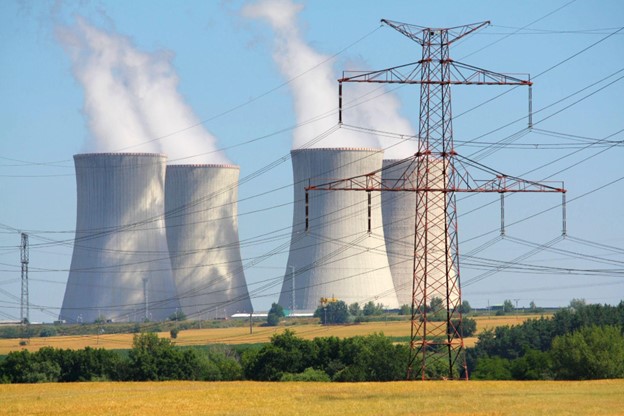
A fission reactor is probably what first comes to mind when you picture a nuclear power plant. The sight of nuclear cooling towers is more common in some parts of the country than others — nearly all of the 94 American reactors are in the East or Midwest.
According to the World Nuclear Association, nuclear reactors are essentially just “large kettles” that generate steam. Because fission is a chain reaction, it doesn’t require a lot of energy to keep it running, and nuclear power plants can operate for decades simply by replacing the uranium pellets that provide the fissile material.
There are several drawbacks to using nuclear fission, though, including the amount of radioactive waste it generates and the risk of a nuclear meltdown. New reactor designs, such as sodium-cooled fast reactors, would reduce the risk by replacing water with a more effective cooling system.
Can Reactions Be Controlled?
Using nuclear fission or fusion to produce electricity requires us to be able to control the process, although one important difference between nuclear fission reactions and nuclear fusion reactions is the means of control.
An uncontrolled fission reaction could lead to a meltdown. Since fission is a chain reaction that will continue as long as there are free neutrons, the primary way to control a fission reaction is to use control rods made out of cadmium or another element that absorbs neutrons.
To control fusion in a tokamak, operators would need to remove the fuel source, such as tritium or deuterium, or reduce the pressure on the plasma.
Switch Plans Anytime, With Zero Fees
Say goodbye to restrictions and hello to freedom. Switch your plan anytime, at zero cost, and discover the perfect energy fit for your lifestyle.
Does Fusion Gain or Lose Energy?
For fusion power reactors to be a practical means of generating electricity, their energy output needs to be greater than their energy input. This concept is expressed using the fusion energy gain factor (Q), in which Q=1 is considered “breakeven.”
Scientists only recently managed to reach the breakeven point at the National Ignition Facility in California. Lasers delivered 2.05 megajoules of energy to hydrogen atoms, which produced 3.15 megajoules (roughly Q = 1.4).
Until then, only hydrogen bombs had an energy gain factor greater than one. Yet, it’s important to note that this number only factors in the amount of energy delivered to the atoms. The lasers used nearly 100 times as much energy, which means this method wouldn’t achieve “economic breakeven” in the energy market.
How Important Are Fission and Fusion?
 source
Nuclear energy makes up a significant portion of the U.S. energy mix — and even more in countries like France. But aging power plants and the fear of a nuclear disaster put its future in question. In fact, after decades of debate, Germany shut down its last three nuclear plants in April 2023.
Although renewable energy sources like wind and solar are on the rise, natural gas and coal consumption are holding steady and even increasing in some countries. Reaching net zero carbon emissions will likely require a rethink of nuclear power and further fusion research.
Over the last several decades, there have been numerous technological advances to take us into the future. It’s entirely possible that the fusion and fission reactors of tomorrow will look nothing like the reactors we’re familiar with today.
Brought to you by justenergy.com
All images licensed from Adobe Stock.
Featured image: