

As the world becomes more environmentally conscious in the face of climate change, the demand for green technology rises to help reduce greenhouse gas (GHG) emissions and increase sustainability. The increasing need for solar panels brings with it the need for space required for these panels. Often, this space is found on the roofs of houses, but what about large solar farms? These require serious real estate, which may not always be available.As the world becomes more environmentally conscious in the face of climate change, the demand for green technology rises to help reduce greenhouse gas (GHG) emissions and increase sustainability. The need for solar panels brings with it the need for space required for these panels. Often, this space is found on the roofs of houses, but what about large solar farms? These require serious real estate, which may not always be available.
The floating solar farm is one of the most innovative and efficient forms of green technology that bypasses this need. These solar farms are not only environmentally friendly but also offer unique benefits that traditional solar farms cannot.
Let’s explore the concept of floating solar farms and their potential impact on the future of renewable energy.
What Are Floating Solar Farms?
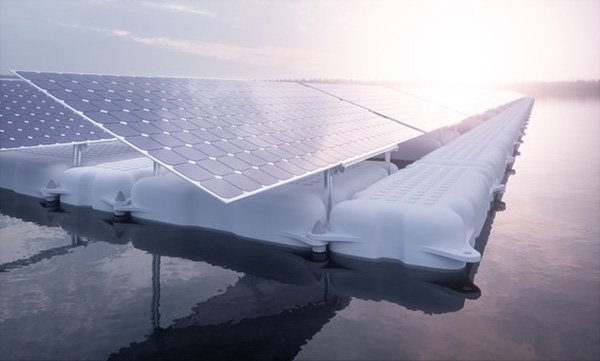
Floating solar farms, also known as floating photovoltaic (PV) systems or floatovoltaics, are solar panels installed on bodies of water, such as lakes, water reservoirs, and even the ocean. These solar panels are on floating structures anchored to the floor of the body of water. The panels connect to a power grid and their energy heads to nearby communities or organizations for consumption.
What Are the Benefits of Floating Solar Farms?

Floating solar farms, of course, have the benefit of offering green energy, but that’s true of any solar power system. However, they stand out from everyday solar panel farms in several ways.
Efficient Use of Space
The biggest benefit of floating solar farms is how efficiently they use space. Typical ground-mounted solar farms need large areas of land, which is costly and difficult to find in densely populated areas. By placing the solar panels in water, these floating solar farms can deliver renewable energy without taking up valuable land space. This can save money and reserve land for the world’s growing population.
Increased Energy Production
A water-cooled solar panel generally delivers 5 to 6% more energy than an air-cooled unit. Floating solar modules essentially have unlimited water to keep them cool, allowing these floating solar power plants to produce more energy than land-based solar systems.
Reduced Water Evaporation
These floating solar installations also help to reduce water evaporation. This can come in handy anywhere, but it’s especially beneficial in areas that experience droughts, as these floating solar plants help maintain water levels in reservoirs so people in the communities they serve have ample fresh drinking water.
This is also beneficial when combined with another form of green energy: hydropower. When floating photovoltaic systems are installed on hydropower reservoirs, they reduce evaporation from the reservoir, ensuring there is more than enough water for power generation.
Lots of Sun
Bodies of water typically have a fairly wide-open view of the sky. This means the solar panels will get plenty of sunlight, ensuring they deliver peak energy numbers the entire time the sun is shining.
Fewer Algae Blooms
Algae, which can often harm aquatic ecosystems, need sunlight to grow, and floating solar farms prevent a lot of light from reaching the water. This can help reduce the frequency and severity of harmful algae blooms, helping the local marine life.
What Are the Disadvantages of Floating Solar Arrays?
While they have many benefits, floating solar projects have some downsides. Let’s review them.
Higher Cost
While floating solar farms are more efficient and require no real estate to place them on, they are generally 10 to 15% more expensive to build. That said, water’s cooling effect helps increase the solar panels’ lifespan and reduce maintenance and replacement costs.
Not for Everyone
The other big downside is that floating solar photovoltaic farms are generally large-scale operations used to power communities, corporations, or utility companies. They’re not designed for single-home use. Plus, to reap the benefits of these panels, you must be in proximity to a large enough body of water. This is why most households with solar power stick to roof-mounted units.
Complex Racking System
In a ground-mounted solar farm, the racking system is relatively simple, and flaws are easy to fix. The racking system in a floating solar farm is not easy to repair because it’s partially underwater. So, the installing company must make complex floating racks with proper anti-corrosion coatings and other water-friendly additions to keep the panels afloat for 25 years or more.
Find out why over a million customers trust Just Energy!
Disrupting Marine Ecosystems
Just like humans, marine life needs a place to live, and many species prefer waters with more sunlight. Placing acres of solar panels on a body of water blocks the sun from hitting the water, making it less hospitable to species that thrive in sunny marine environments. The blocked light can also lead to a general cooling of a body of water, which may hurt various marine life species.
Site Complications
Floating solar farms can’t be placed in every body of water. They require tranquil waters and calm winds. If you put floating solar panels in bodies of water with even moderate waves, it can cause issues, such as damage to the floating racks or the solar panels themselves. High winds coming across the body of water can also lead to panel or rack damage. This makes finding the perfect floating solar farm site a bit of a challenge.
Where Is the Largest Floating Solar Power Plant in the US?
You’ll notice the U.S. is still a little behind in this area, but we are making some headway. Currently, the largest floating solar farm in the U.S. is in New Jersey.
This floating solar farm produces 8.9 mW of electricity, comprises 16,510 individual solar panels, and spans 17 acres of the Canoe Brook reservoir in Short Hills, New Jersey. While that is a massive solar system compared to the typical household system, it’s a fraction of the output of the tenth-ranked floating solar system in the world: South Korea’s 41-mW Hapcheon Dam floating PV power plant.
So, what’s the main purpose of the Short Hills, NJ plant? It provides about 95% of the power demands at the Canoe Brook Water Treatment Plant.
The largest floating solar farm in the U.S. that provides electricity to the public is the Healdsburg Floating Solar Farm in Healdsburg, California. Its 11,600 panels sit atop a pair of ponds at the city’s wastewater plant and produce 4.8 mW of electricity. That’s enough to meet 8% of the city’s power needs annually.
What Does the Future Hold for Floating Solar Farms?
While floating solar is still developing, it has a bright future in the eyes of many experts. A recent global study looked at all reservoirs with an area of at least 0.1 square kilometers to determine the potential for installing additional floating solar. The research found 114,555 potential reservoirs worldwide with a total area of 554,111 square kilometers.
The study assumed covering up to 30% of each reservoir’s total area up to 30 square kilometers and found that these solar farms could produce a total of 9,434 terawatt-hours TWh of energy. For reference, the entire United States of America consumed 4,048 Terrawatts of electricity in 2022.
Of course, that 9,434 TWh of energy is global production. How does that break down by countries with the highest production potential? The U.S. rings in at the top with enough reservoirs to produce 1,911 TWh of energy. After that comes China at 1,107 TWh and Brazil at 865 TWh per year.
And this is all at today’s efficiency rates, as the study used a current Panasonic solar panel as its baseline panel with an efficiency of 18.6%. Some experts believe high-end solar panels could be closer to 27% efficient by 2027, meaning the TWh production could be even higher.
On top of covering nearly half of the power demands of the U.S., these floating solar farms could reduce evaporation from the reservoirs by 106 cubic kilometers. This is certainly another huge benefit, especially considering that 2,561 of these reservoirs already have hydroelectric plants on them, so the water level is critical in ensuring the power keeps flowing from them.
Floating Solar Farms May Be the Future, But You Can Reduce Electricity Costs Today
Floating solar farms are a prime example of how technology can be used to harness the power of the sun in an environmentally friendly and efficient way. As the world continues to shift toward renewable energy sources, floating solar farms have the potential to play a significant role in meeting the demand for clean energy.
Floating solar farms aren’t widespread enough to help most households reduce their reliance on fossil fuel-sourced electricity and help you save money on your bills. Fortunately, JustEnergy can step in to help with one of its money-saving electricity plans. Check out these electricity plans and find one that suits your needs today.
Brought to you by justenergy.com
All images licensed from Adobe Stock.